The right air filter stops most of it before it reaches your family.
What separates an effective ragweed filter from one that just looks good on a shelf comes down to MERV rating, filter media construction, and replacement timing during peak pollen season. On this page, we share exactly what we recommend to help you choose the right air filter home fit for cleaner indoor air — and why — based on real manufacturing insight and the patterns we see across millions of homes every allergy season.
TL;DR Quick Answers
What is the best home air filter for ragweed season?
The best home air filter for ragweed season is a pleated MERV 11 or MERV 13 filter with electrostatically charged media. Here is what that means in practice:
MERV 11 — best for most households dealing with standard ragweed allergy symptoms
MERV 13 — best for severe allergies, asthma, or immunocompromised family members
Flat-panel fiberglass filters — not adequate for ragweed season regardless of price
Three things that matter as much as MERV rating:
Install before August — before ragweed season peaks, not after symptoms start
Check at 30 days — peak pollen loads saturate filters in four to six weeks, not 90 days
Choose pleated over fiberglass — electrostatically charged pleated media captures fine ragweed pollen that flat-panel filters miss entirely
After manufacturing air filters for over a decade and serving more than two million households, the pattern is consistent. The right filter, installed on time and changed on schedule, is the single most effective step a homeowner can take to protect indoor air quality during ragweed season.
Top Takeaways
Ragweed is an HVAC problem before it is an allergy problem. Unfiltered pollen gets pulled through return vents and recirculated through every room. The right filter — installed and maintained correctly — is what turns your home into an actual refuge.
MERV rating and filter media construction both determine real-world performance. MERV 11 is the practical starting point for most households. MERV 13 is right for severe allergies, asthma, or immunocompromised family members. Electrostatically charged pleated media outperforms flat-panel fiberglass at the same rating every time.
Standard 90-day replacement cycles were not built for ragweed season. Peak pollen loads can saturate a filter in four to six weeks. Three things to remember:
Install before August
Check at 30 days
Replace based on what you see — not what the calendar says
Ragweed season is getting longer — your filter schedule needs to reflect that. EPA data shows ragweed season has extended by up to 21 days in key Midwest markets since 1995. A schedule built around historical averages is already behind the season your family is living through.
Preparation outperforms reaction every time. After manufacturing filters for over a decade and serving more than two million households, the pattern is consistent. The families who breathe easiest during ragweed season share three habits:
Filter selected and installed before August
MERV rating matched to household sensitivity — not defaulted to whatever was already in the slot
Filter checked at 30 days during peak weeks — not left until symptoms signal a problem
Why Ragweed Is Harder to Filter Than Most Homeowners Expect
Not all pollen behaves the same way inside a home. Ragweed pollen is exceptionally lightweight and jagged in shape, which allows it to stay airborne far longer than heavier spring pollen like oak or maple. That airborne quality is exactly what makes it so effective at penetrating standard filtration and why a top air filter matters so much in the homes we serve well into October.
What surprises most homeowners is that indoor ragweed concentrations can exceed outdoor levels. Every HVAC cycle pulls unconditioned air through return vents, and without the right filter in place, that pollen gets conditioned and redistributed throughout the house. The system designed to keep your family comfortable becomes the mechanism spreading the problem.
The Best MERV Rating for Ragweed Season
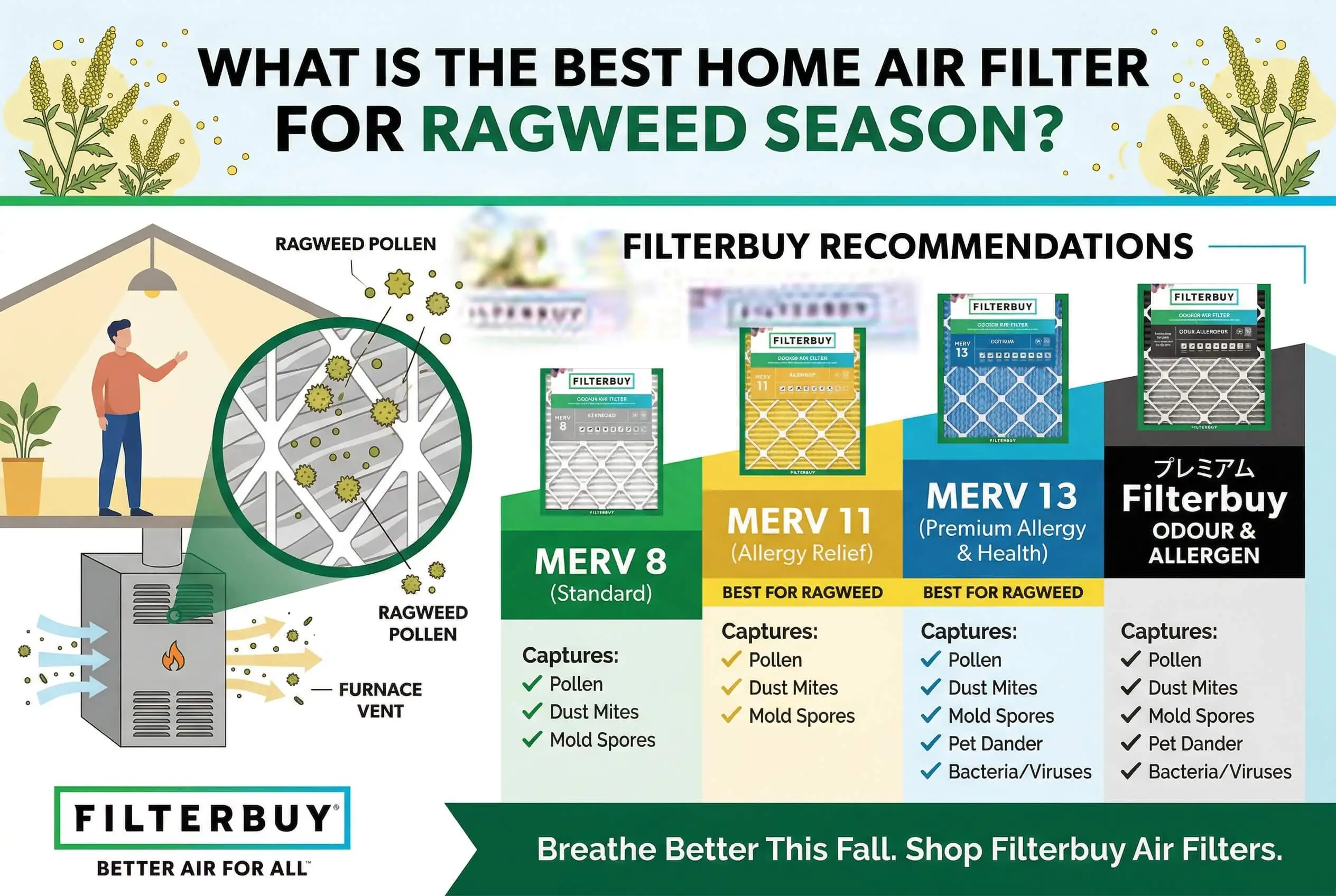
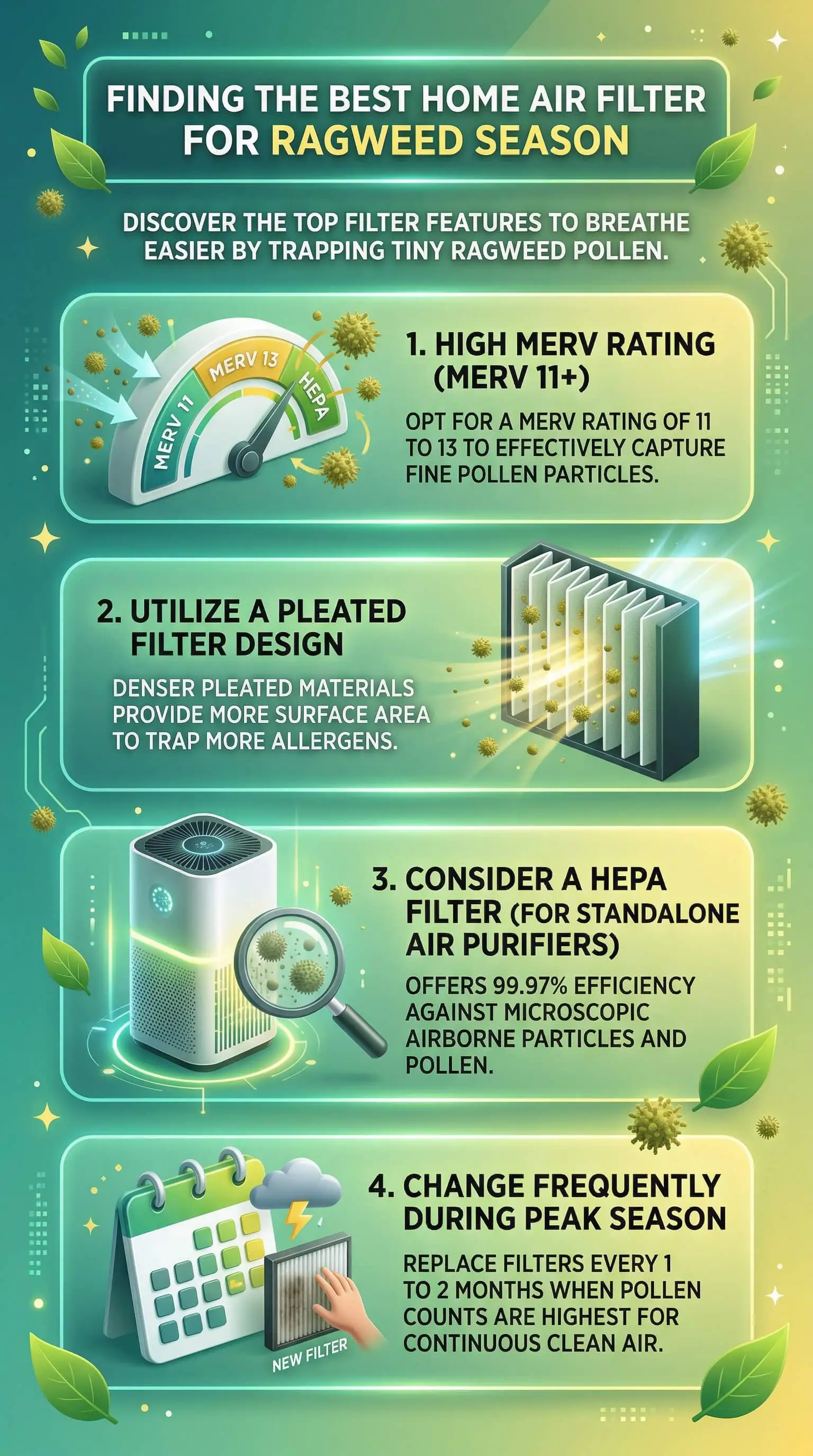
For ragweed pollen specifically, a MERV 11 filter is the most practical starting point for most homes. Here is why that rating matters:
MERV 8 filters capture larger particles effectively but begin to miss finer pollen grains and the mold spores that often accompany late-season ragweed.
MERV 11 filters capture particles down to 1.0–3.0 microns, which covers ragweed pollen, most mold spores, and fine dust with meaningful efficiency.
MERV 13 filters offer the highest residential-grade filtration we manufacture — capturing particles as small as 0.3–1.0 microns — and are the right choice for households with severe ragweed allergies, asthma, or members who are immunocompromised.
The important caveat: a higher MERV rating is only beneficial if your HVAC system can handle the increased airflow resistance. After manufacturing filters for over a decade, we consistently advise homeowners to check their system's specifications before moving to MERV 13. An undersized blower motor forced to pull air through a dense filter media can run less efficiently and wear faster over time.
Why Filter Media Construction Matters as Much as MERV Rating
MERV rating tells you what a filter is designed to capture. Filter media construction tells you how well and how consistently it actually does it.
Electrostatically charged synthetic media — the type used in Filterbuy's pleated filters — attracts airborne particles the way a magnet attracts metal shavings. This charge-based capture mechanism is particularly effective against the fine particles ragweed pollen breaks into once it desiccates indoors. Flat-panel fiberglass filters carry no electrostatic charge and, regardless of their stated MERV rating, tend to underperform during high-pollen periods when fine particle loads are elevated.
Pleat density also plays a role. More pleats mean more surface area, which means the filter can capture more without restricting airflow as quickly — a balance that matters most during the sustained pollen loads of a full ragweed season.
How Often to Change Your Filter During Ragweed Season
Standard filter change guidance — every 60 to 90 days — is calibrated for average conditions. Ragweed season is not average.
During peak ragweed season, typically late August through October depending on your region, we recommend checking your filter every 30 days. A filter that would normally last 90 days can become visibly loaded with pollen and debris within four to six weeks when outdoor pollen counts are elevated. A clogged filter does not just stop filtering — it actively restricts airflow, forces your HVAC system to work harder, and can begin releasing trapped particles back into circulation.
The practical test: hold your filter up to a light source. If you cannot see light through the media, it is time to replace it regardless of how recently you installed it.
What Else Can Strengthen Your Home's Defense During Ragweed Season
A quality filter is the foundation of ragweed defense — but it works best as part of a broader strategy. Based on patterns we observe across the households we serve, these steps make a measurable difference:
Keep windows and exterior doors closed during peak pollen hours, typically morning through early afternoon.
Change clothes and shower after spending extended time outdoors before pollen gets transferred to furniture and bedding.
Vacuum with a HEPA-equipped vacuum two to three times per week to remove settled pollen before it re-enters circulation.
Inspect your return air vents for gaps around the grille — even a small air gap bypasses your filter entirely and lets unfiltered air into your system.
The filter is the last line of defense after all of those steps. When it is the right MERV rating, built from the right materials, and replaced on a schedule that reflects actual conditions — not a calendar assumption — it can meaningfully reduce the ragweed burden your family breathes during the worst weeks of allergy season.
"Ragweed season exposes something we see play out in homes every fall — most families are running the right HVAC system with the wrong filter. A MERV 8 that works fine eleven months of the year simply was not built for the fine, lightweight pollen loads ragweed produces. After manufacturing filters for over a decade, the pattern we keep coming back to is this: filter performance is not just about what a filter is rated to capture — it is about what the media is constructed to hold onto under sustained load. During peak ragweed weeks, that distinction is the difference between a filter that protects your family and one that gives the appearance of protection."
Essential Resources
After manufacturing air filters for over a decade and serving more than two million households, we know that protecting your family during ragweed season goes beyond swapping out a filter. It requires understanding what ragweed pollen actually does inside your home, which filter ratings are built to stop it, and how to stay ahead of the season before your family feels the impact. These seven resources give you that full picture — curated specifically for the homeowner who takes indoor air seriously.
What Your Filter's MERV Rating Actually Means for Ragweed
Most homeowners have seen the term MERV on a filter label without fully understanding what it's telling them. The EPA's MERV rating reference breaks down exactly how the rating scale works, which particle sizes each rating level targets, and why upgrading to a higher-rated filter is especially important when lightweight ragweed pollen is in the air. It's the first resource we point to when a customer asks where to start.
https://www.epa.gov/indoor-air-quality-iaq/what-merv-rating
How to Choose the Right Filter and Air Cleaner for Your Home
Not every HVAC system can handle every filter — and choosing one that's too restrictive can strain your system as much as running a clogged filter. The EPA's Guide to Air Cleaners in the Home walks you through how to match filter selection to your system's actual capacity, covering MERV ratings, portable air cleaners, and how filtration and ventilation work together during high-pollen periods.
https://www.epa.gov/indoor-air-quality-iaq/guide-air-cleaners-home
Why Ragweed Pollen Is an Indoor Air Quality Problem, Not Just an Outdoor One
Here's something most homeowners don't realize: pollen is officially classified as a biological indoor contaminant by the EPA — in the same category as mold spores, dust mite debris, and pet dander. This resource explains how biological pollutants enter your home, how they accumulate on indoor surfaces, and why the health effects extend well beyond sneezing and watery eyes.
https://www.epa.gov/indoor-air-quality-iaq/biological-pollutants-impact-indoor-air-quality
The Most Trusted Resource on Ragweed Season Timing and Health Impact
When we work with allergy-sensitive households, one of the first things we tell them is to know their local ragweed calendar. The Asthma and Allergy Foundation of America's ragweed resource details exactly when season starts and peaks by region, which symptoms are most common, and why nearly 50 million Americans are affected each year — the context you need to time your filter replacements around actual pollen conditions, not a generic schedule.
https://aafa.org/allergies/types-of-allergies/pollen-allergy/ragweed-pollen/
Understanding Why Ragweed Pollen Is Harder to Stop Than Other Seasonal Pollens
Ragweed behaves differently than spring pollens — and after years of seeing how it affects homes across the country, we can tell you that most families underestimate it. The Allergy & Asthma Network explains why a single ragweed plant can release up to one billion pollen grains, how its lightweight structure keeps it airborne and traveling far longer than heavier pollen, and how to track local pollen counts during the weeks your filter is working hardest.
https://allergyasthmanetwork.org/allergies/pollen-allergy/ragweed-allergy/
Track Outdoor Air Quality So You Know When Your Filter Is Under the Most Pressure
During peak ragweed weeks, outdoor particle loads spike — and every time your HVAC system runs, it's pulling that air through your filter. AirNow.gov is the EPA's official daily air quality tool, giving you real-time AQI readings for your area so you can make informed decisions about when to keep windows closed, when to run your system longer, and when it's time to check your filter ahead of schedule.
Know When Ragweed Season Demands a Faster Filter Replacement Schedule
Standard filter replacement guidance is built around average conditions — and ragweed season is not average. The U.S. Department of Energy's HVAC maintenance resource explains why filter replacement frequency should increase during periods of heavy system use, and what happens to your system's efficiency and air quality when a clogged filter goes unchanged for too long. In our experience, this is the step most homeowners skip — and the one that makes the biggest difference.
https://www.energy.gov/energysaver/air-conditioner-maintenance
Supporting Statistics
Most homeowners think ragweed is an outdoor problem. What we see across the homes we serve tells a different story.
Americans spend approximately 90 percent of their time indoors, where concentrations of some pollutants are often 2 to 5 times higher than typical outdoor levels.
After more than a decade of manufacturing air filters, this is the statistic that reframes every conversation we have about seasonal allergies. Here is what that looks like inside a real home during ragweed season:
Ragweed pollen enters through return vents every time your HVAC system cycles
It settles on surfaces and resuspends back into circulation with air movement
Homes where symptoms persist deepest into fall are almost always running the wrong filter — or no filter change at all
Indoors is not a refuge from ragweed. It becomes one only when the right filter is doing its job.
Source: U.S. Environmental Protection Agency — Indoor Air Quality https://www.epa.gov/report-environment/indoor-air-quality
Nearly 50 million Americans experience ragweed allergy symptoms each fall, with peak exposure running from August through the first frost and concentrating most intensely in mid-September.
Serving over two million households gives us an unusually clear view of how unevenly prepared most homes are when ragweed season arrives. The families who feel it least share a few consistent habits:
They changed their filter before August — not after symptoms started
They chose a MERV rating matched to their household's actual sensitivity
They checked the filter again at 30 days rather than waiting the standard 90
Fifty million people share this allergy. Far fewer are protecting their indoor air in a way that reflects that reality.
Source: Asthma and Allergy Foundation of America — Ragweed Pollen Allergy https://aafa.org/allergies/types-of-allergies/pollen-allergy/ragweed-pollen/
The ragweed pollen season grew longer at 8 of 9 study locations across the Midwest between 1995 and 2015 — with Fargo, North Dakota recording a 21-day increase and Minneapolis, Minnesota seeing an 18-day extension.
This is the number that most directly challenges the filter replacement schedules we still see in countless homes. A few things that data makes clear:
Standard 90-day replacement cycles were calibrated for average seasonal conditions that no longer exist
In northern markets especially, ragweed season keeps getting longer each year
A filter installed in late July and left unchanged through October is not protecting a household the way its owner believes it is
The season has grown. The schedule needs to grow with it.
Source: U.S. Environmental Protection Agency — Climate Change Indicators: Ragweed Pollen Season https://www.epa.gov/sites/default/files/2016-08/documents/print_ragweed-2016.pdf
Final Thoughts
Ragweed season arrives at the same time every year. The damage it does inside poorly filtered homes does not have to.
After more than a decade of manufacturing air filters and serving over two million households, our perspective on ragweed has shifted in one important way. Ragweed is an HVAC problem before it is an allergy problem.
The moment pollen enters your return air system without adequate filtration, the battle moves indoors — and most families do not realize they have already lost ground before symptoms appear.
That insight changes everything about how we approach filter selection, MERV ratings, and replacement timing. Here is what our manufacturing experience and customer data consistently point to:
MERV 11 is the practical starting point for most ragweed-affected households
MERV 13 is the right choice for severe allergies, asthma, or immunocompromised family members
Installation before August matters more than most homeowners realize
A 30-day check during peak season outperforms a standard 90-day replacement cycle every time
Closed windows during peak pollen hours extend the life and effectiveness of any filter
The homeowners who breathe easiest during ragweed season are not the ones who responded to symptoms. They are the ones who anticipated them.
One more thing worth stating plainly: ragweed season is getting longer. A 90-day filter cycle made sense when seasons were shorter and pollen loads were lighter. Neither of those things is true anymore. The filter standing between your family and an increasingly prolonged ragweed season, along with aluminum foil tape for hvac systems that helps support overall system performance, costs a fraction of a single allergy-related medical visit and works every hour your HVAC system runs, whether you are thinking about it or not.
That is the part most people never see. Making it visible is what we do.
FAQ on Air Filters for Home
Q: What is the best MERV rating for a home air filter during ragweed season?
A: MERV 11 is the right starting point for most homes. MERV 13 is the stronger choice for severe allergies, asthma, or immunocompromised family members. The most common mistake we see across the homes we serve:
Running a year-round MERV 8 filter without upgrading before ragweed season starts
Waiting until symptoms appear before making the change
Choosing a filter based on price rather than household sensitivity
Upgrading to MERV 11 or MERV 13 before August consistently separates households that struggle during ragweed season from those that do not.
Q: How often should I change my home air filter during ragweed season?
A: Every 30 days — not the standard 90. Peak ragweed pollen loads can saturate a filter in four to six weeks. Based on patterns we see across millions of filter change cycles:
Check your filter every 30 days from late August through the first frost
Replace when light no longer passes through the media
Do not wait for allergy symptoms — by then the filter is already recirculating captured particles
The 90-day guideline was not written for ragweed season. Do not treat it like it was.
Q: Can my home HVAC system handle a MERV 13 filter?
A: Most modern systems can — with one condition. MERV 13 media is denser and creates more airflow resistance. Two things to do before upgrading:
Confirm compatibility with your system manual or a qualified HVAC technician
Commit to a 30-day check schedule — a MERV 13 filter left too long strains a blower motor more than a lower-rated filter would
If MERV 13 is not compatible, MERV 11 handles ragweed season effectively without the same airflow demands. The filter matched to your system and changed on schedule always outperforms a higher-rated filter left in too long.
Q: Does closing windows during ragweed season actually improve indoor air quality?
A: Yes — but not enough on its own. Closing windows cuts the most direct pollen entry point, especially during peak morning hours. What still gets through regardless:
Return air gaps around vent grilles and filter slots
Pollen carried in on clothing, hair, and pets
Brief door openings throughout the day
After a decade of manufacturing filters and observing how homes perform during ragweed season, the conclusion is consistent. Closed windows reduce pollen volume. The right HVAC filter handles what gets through. Both are necessary. Neither works as well without the other.
Q: Is a flat-panel fiberglass filter good enough for ragweed season?
A: No. The cost difference between a fiberglass filter and a pleated MERV 11 is small. The performance gap during ragweed season is not. Here is why fiberglass falls short:
Fiberglass filters carry MERV ratings between 1 and 4
They protect HVAC equipment from large debris — not fine biological particles
They carry no electrostatic charge — relying entirely on mechanical interception
They cannot sustain performance under the elevated pollen loads ragweed season produces
Electrostatically charged pleated media attracts fine ragweed pollen at the media level. It holds more before restricting airflow. It performs consistently across the full length of the ragweed season. For ragweed filtration, media construction is as decisive as MERV rating. Flat-panel fiberglass falls short on both.
Ready to Find the Best Home Air Filter for Ragweed Season?
Ragweed season is predictable — your filter plan should be too. Shop Filterbuy's MERV 11 and MERV 13 pleated air filters, manufactured in the USA and delivered direct to your door before peak season hits.