Most homeowners assume all air filters work the same way. After manufacturing filters for over a decade and helping more than two million households breathe cleaner air, we can tell you — they don't.
A regular air filter captures what's floating through your air: dust, pollen, pet dander, mold spores. A carbon filter targets what's hiding in it: odors, gases, and chemical compounds that standard filters pass right through. Same slot in your HVAC system. Completely different job.
What surprises most of our customers isn't the difference itself — it's discovering that the filter they've trusted for years was never designed to handle half the pollutants in their home. This page gives you the full picture: what each filter type actually removes, where each one falls short, and how to choose the right protection for your household.
TL;DR Quick Answers
carbon filter
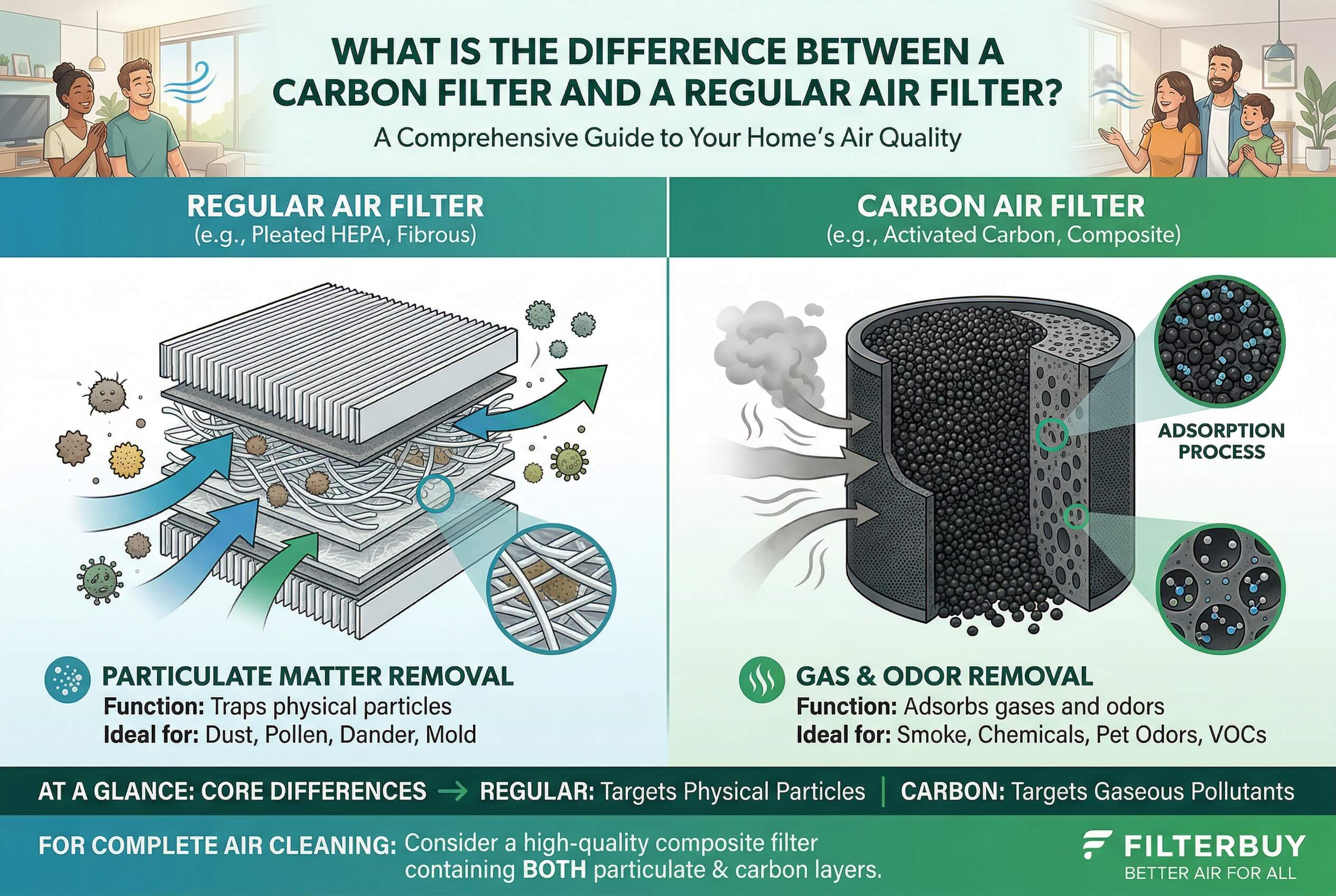
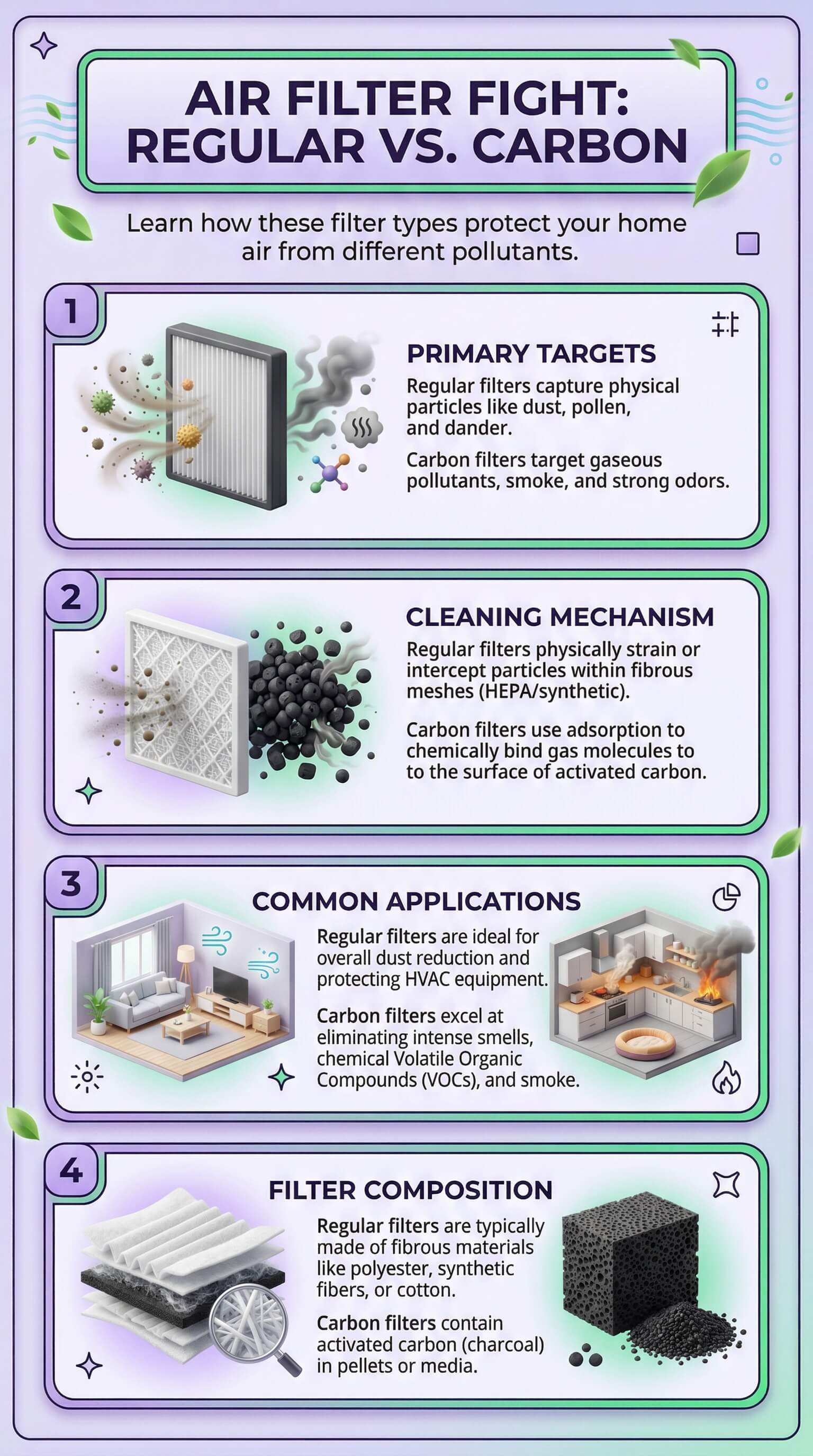
A carbon filter is an air filter that uses activated carbon to adsorb gases, odors, and volatile organic compounds (VOCs) from indoor air. Unlike a regular mechanical filter — which physically traps airborne particles like dust, pollen, and pet dander — a carbon filter targets the chemical compounds and odors that a standard filter passes right through.
Key facts about carbon filters:
How it works: Activated carbon bonds gas molecules to its surface through a process called adsorption as air passes through your HVAC system
What it removes: Cooking odors, pet odors, tobacco smoke byproducts, VOCs, formaldehyde, and household chemical compounds
What it doesn't remove: Airborne particles — a mechanical filter handles those
Best use: Paired with a pleated mechanical filter for complete particle and gas filtration in one filter change
Replacement cycle: Every 90 days under typical household conditions; every 60 days in homes with pets, smokers, or high cooking activity
Who needs it most: Households with pets, new construction homes, recently renovated spaces, high-activity kitchens, and anyone with chemical sensitivities
After manufacturing filters for over a decade and serving more than two million households, the clearest guidance we offer is this: a carbon filter and a regular air filter are not interchangeable — they are complementary. Most households need both.
Top Takeaways
Regular filters and carbon filters solve different problems — and neither can do the other's job.
Mechanical filters capture particles: dust, pollen, pet dander, mold spores
Using only one when your home needs both leaves half your air quality problem unaddressed
MERV ratings only tell half the story.
MERV measures particle capture efficiency — nothing more
A MERV 13 filter has zero impact on chemical compounds and odors
Choosing a filter by MERV rating alone is only half a decision
Indoor VOC concentrations can run up to 10 times higher than outdoors — and your regular filter can't touch them.
Sources are already in your home: paints, cleaning products, building materials, furnishings
EPA research confirms indoor VOC levels consistently exceed outdoor levels regardless of location
A mechanical filter was never designed to address any of it
The best indoor air quality comes from using the right filter — not just the highest-rated one.
After a decade of manufacturing and two million households served, this is the most consistent pattern we've observed
Filter type matters as much as filter rating
Most households need both particle and gas filtration — at the same time.
Cooking, cleaning, owning pets, and daily activity generate both pollutant categories simultaneously
A combined carbon and mechanical filter addresses both threats in a single filter change
Complete indoor air protection doesn't have to be complicated
How a Regular Air Filter Works
A regular air filter — also called a mechanical filter — does exactly what the name suggests. It physically intercepts airborne particles as air moves through your HVAC system. The filter media, typically a pleated synthetic or fiberglass material, creates a barrier that traps contaminants before they recirculate through your home.
What a Regular Filter Captures
Dust and household debris
Pollen and mold spores
Pet dander
Lint and carpet fibers
Some bacteria and fine particles, depending on MERV rating
The higher the MERV rating, the smaller the particles a filter can capture. A MERV 8 handles everyday household dust. A MERV 13 reaches fine particulate matter that can affect respiratory health. What no MERV rating addresses — regardless of how high it climbs — is airborne gases and odors. That's a structural limitation, not a quality one.
How a Carbon Filter Works
A carbon filter uses activated carbon — a highly porous material processed to create an enormous surface area — to adsorb gases, chemical compounds, and odors from the air. Where a regular filter physically blocks particles, activated carbon chemically binds pollutants to its surface as air passes through.
What a Carbon Filter Targets
Cooking odors and smoke
Pet odors
Volatile organic compounds (VOCs) from paints, cleaning products, and building materials
Formaldehyde and other household chemicals
Tobacco smoke byproducts
In our experience manufacturing filters for over a decade, the customers who benefit most from carbon filtration are those living in newer construction homes, homes with pets, or households where someone has chemical sensitivities. New building materials off-gas VOCs for months after installation — a regular filter won't touch them.
The Core Difference: Particles vs. Gases
This is the distinction that matters most. Regular filters and carbon filters solve two fundamentally different air quality problems.
Regular filters address what's floating in your air — solid particles your lungs shouldn't inhale.
Carbon filters address what's dissolved in your air — chemical compounds and odors your nose detects but your filter ignores.
Neither filter can do the other's job. A MERV 13 filter won't eliminate pet odors. An activated carbon filter won't meaningfully reduce dust or pollen. Treating them as interchangeable is one of the most common mistakes we see homeowners make.
Do You Need One or Both?
For most households, the answer is both — just not always in the same filter.
Some air filters combine pleated mechanical media with an activated carbon layer, offering particle and gas filtration in a single unit. Our Odor Eliminator filter is built exactly this way: it pairs high-efficiency filtration with an activated carbon layer to address both categories of indoor air pollutants in one filter change.
Homes That Benefit Most From Combined Filtration
Households with pets
Homes with smokers
Kitchens with high cooking activity
Newer construction with off-gassing materials
Anyone with allergies compounded by chemical sensitivities
If your air quality challenge is purely particle-based — seasonal allergies, dust, or general HVAC protection — a high-MERV mechanical filter alone will serve you well. If odors or gases are part of the picture, carbon filtration belongs in your strategy.
Which Filter Is Right for Your Home?
Use this as a quick guide:
Dust, pollen, pet dander, or mold: choose a MERV 8, MERV 11, or MERV 13 filter based on your sensitivity level.
Odors, smoke, or chemical compounds: choose a carbon or activated carbon filter.
Both particle and gas concerns: choose a combined carbon + mechanical filter like our Odor Eliminator.
After manufacturing filters for over a decade and serving more than two million households, the most consistent finding we share with customers is this: the right filter for your home depends entirely on what's actually in your air — not just what you can see.
"Most homeowners shop for air filters based on size and price. What they rarely consider is filter type — and that single oversight can leave half their air quality problem completely unaddressed. A MERV 13 filter is exceptional at capturing particles, but it won't touch the VOCs off-gassing from new flooring or the pet odors cycling through your ductwork. After manufacturing filters for over a decade and working with more than two million households, the pattern is clear: the homes with the best indoor air quality aren't necessarily using the highest-rated filter — they're using the right filter for what's actually in their air."
Essential Resources
Don't take your indoor air for granted. The resources below are the ones we point our own customers to — curated from federal agencies and our own resource center — to help you make a confident, informed decision about carbon filtration and what it means for your home.
1. The Federal Guide That Explains Exactly What Each Filter Type Can — and Can't — Do
If you're trying to understand the difference between a mechanical filter and a carbon filter, start here. The EPA's Guide to Air Cleaners in the Home breaks down how gas-phase and particle filters work, what each one removes, and how to match the right filter type to the air quality challenges actually present in your home.
https://www.epa.gov/indoor-air-quality-iaq/guide-air-cleaners-home
2. The Invisible Threat Your Current Filter Is Ignoring — VOCs in Your Home
Most homeowners don't realize that VOC concentrations indoors can run up to ten times higher than outdoors — and the sources are products already in your home: paint, cleaning supplies, building materials, and furnishings. This EPA resource identifies where VOCs come from and why they matter for your family's health, giving you the context to understand what a carbon filter is actually protecting you from.
https://www.epa.gov/indoor-air-quality-iaq/volatile-organic-compounds-impact-indoor-air-quality
3. What VOCs Actually Are — Before You Choose a Filter to Fight Them
Before you can protect your home from volatile organic compounds, you need to know what they are and where they're hiding. This EPA primer defines VOCs in plain language, maps them to their most common household sources, and explains how they enter your indoor air — the essential foundation for any homeowner researching carbon filtration.
https://www.epa.gov/indoor-air-quality-iaq/what-are-volatile-organic-compounds-vocs
4. MERV Ratings Explained — And Why Even a MERV 13 Won't Eliminate Odors or Gases
Serving over two million households has taught us that MERV ratings are one of the most misunderstood specs in home filtration. This EPA explainer clarifies what MERV ratings actually measure — particle capture efficiency — and why even the highest-rated mechanical filter has zero impact on VOCs, odors, or chemical compounds. If you're relying on MERV alone, this is a must-read.
https://www.epa.gov/indoor-air-quality-iaq/what-merv-rating
5. Why "Low VOC" Labels Don't Always Mean Your Indoor Air Is Safe
This is one of the most important — and most overlooked — resources for homeowners evaluating carbon filtration. The EPA explains why products labeled "no VOC" or "low VOC" under federal law can still contain toxic volatile chemicals that affect your indoor air quality. If you've ever assumed a product was safe because of its label, this resource will change how you shop and how you protect your home.
6. The Industry Standard Behind Every MERV Rating — Straight From ASHRAE
ASHRAE is the engineering body that developed the MERV rating system and sets the filtration benchmarks that every filter manufacturer — including Filterbuy — is measured against. This resource addresses real-world filter efficiency, performance standards, and what those ratings mean when your HVAC system is actually running in a residential home environment.
https://www.ashrae.org/technical-resources/filtration-and-disinfection-faq
7. Does an Activated Carbon Filter Actually Remove VOCs? — Filterbuy Resource Center
After manufacturing filters for over a decade and helping more than two million households breathe cleaner air, we put everything we've learned into this resource. It covers what activated carbon adsorption actually does, which VOCs and odors carbon filters address, when to replace your filter, and how to pair carbon filtration with a mechanical filter for complete indoor air protection — particles and gases, handled together.
Supporting Statistics
After manufacturing filters for over a decade and working with more than two million households, we know these four statistics change how homeowners think about the air their families breathe every day.
90% of Your Life Is Spent Breathing Indoor Air
Most homeowners focus on outdoor air quality. The real threat is closer to home.
According to the EPA:
Americans spend approximately 90% of their time indoors
Indoor pollutant concentrations are often 2 to 5 times higher than outdoors
The most vulnerable household members — children, older adults, those with respiratory conditions — spend even more time indoors than average
Filter selection isn't a maintenance task. It's a daily health decision made by default every time your HVAC system runs.
Source: U.S. Environmental Protection Agency — Indoor Air Quality https://www.epa.gov/report-environment/indoor-air-quality
VOC Concentrations Inside Your Home Can Run Up to 10 Times Higher Than Outdoors
One of the most consistent things we hear from customers after switching to carbon filtration: "I didn't realize how much was in my air."
The EPA's research gives that reaction a hard number:
VOC concentrations indoors run up to 10 times higher than outdoors
VOCs are emitted by products numbering in the thousands — paints, cleaning supplies, furniture, building materials
EPA's TEAM studies found organic pollutant levels 2 to 5 times higher inside homes than outside, regardless of location — rural or industrial
Your zip code doesn't determine your exposure. What's in your home? And a MERV-rated mechanical filter was never designed to address any of it.
Source: U.S. Environmental Protection Agency — Volatile Organic Compounds' Impact on Indoor Air Quality https://www.epa.gov/indoor-air-quality-iaq/volatile-organic-compounds-impact-indoor-air-quality
Everyday Activities Spike Indoor VOC Levels Far More Than Most People Realize
In our experience, the homeowners who benefit most from carbon filtration aren't always renovating. They're cooking daily, cleaning regularly, and living actively in their homes.
What the EPA's data shows:
During activities like paint stripping, VOC levels can reach 1,000 times background outdoor levels
Elevated concentrations persist in indoor air for hours after the activity ends
Lower-intensity daily activities produce proportionally smaller spikes — but they happen constantly
A carbon filter running through your HVAC system adsorbs those compounds every time air cycles through. Households with high daily activity consistently see the greatest benefit from combined carbon and mechanical filtration.
Source: U.S. Environmental Protection Agency — Volatile Organic Compounds' Impact on Indoor Air Quality https://www.epa.gov/indoor-air-quality-iaq/volatile-organic-compounds-impact-indoor-air-quality
Indoor Air Pollution Ranks Among the Top 5 Environmental Health Risks in America
This is the statistic that tends to stop people in their tracks — and it's one we share with customers regularly.
Here's what the EPA's own Science Advisory Board has found:
Indoor air pollution consistently ranks among the top five environmental risks to public health
This isn't outdoor smog or industrial emissions — it's the air inside American homes and buildings
The people most vulnerable to poor air quality are also the most exposed to it, spending more time indoors than average
Choosing a filter that addresses both particles and gases is one of the most direct actions a homeowner can take against that risk. We've seen it make a measurable difference in the homes of customers we've served for over a decade.
Source: U.S. Environmental Protection Agency — Why Indoor Air Quality Is Important to Schools https://www.epa.gov/iaq-schools/why-indoor-air-quality-important-schools
Final Thoughts
Most homeowners come to this topic looking for a simple answer. Carbon filter or regular filter — which one is better?
After manufacturing filters for over a decade and serving more than two million households, our honest answer is this: it's the wrong question.
Neither Filter Is Better. They Solve Different Problems.
A regular mechanical filter — MERV 8, MERV 11, or MERV 13 — intercepts particles: dust, pollen, pet dander, mold spores
A carbon filter targets gases, odors, and chemical compounds that have no physical form for a mechanical filter to catch
VOCs from new flooring, cooking byproducts, cleaning product residue — a MERV-rated filter won't touch any of them
The homes with the cleanest indoor air aren't necessarily using the highest-rated filter. They're using the right combination of filter types for what's actually in their air.
Our Opinion — and We Hold It Firmly
The filter industry has done homeowners a disservice by making MERV ratings the primary language of filter quality. Here's why that matters:
MERV ratings measure one thing only: particle capture efficiency
They say nothing about gases, odors, or chemical compounds
A homeowner who selects a MERV 13 and considers the problem solved may have addressed only half of what's circulating through their home
That's not a failure of the filter. It's a failure of the information available at the point of decision.
Why We Built the Odor Eliminator the Way We Did
Real households generate both categories of pollutants — every single day:
Particles — from dust, pet dander, pollen, and mold
Gases and odors — from cooking, cleaning, VOC off-gassing, and daily activity
Cooking, cleaning, and living actively in your home doesn't create a particle problem or a gas problem. It creates both — simultaneously — in the same air your family breathes. Our Odor Eliminator pairs electrostatically charged pleated media for particle capture with an activated carbon layer for gas and odor adsorption because that's what real households actually need.
The right filter for your home depends on understanding what's in your air. We hope this page made that invisible picture a little more visible.
FAQ on Carbon Filters
Q: What is the difference between a carbon filter and a regular air filter?
A: They solve two completely different air quality problems.
Regular filters physically block particles: dust, pollen, pet dander, mold spores
Carbon filters chemically bind gases, odors, and VOCs to an activated carbon surface
Both fit the same slot in your HVAC system — but neither can do the other's job
After manufacturing both filter types for over a decade, the pattern we see most often is homeowners running a high-MERV filter and wondering why their home still smells. The filter is working perfectly. It was just never built for that problem.
Q: Do carbon filters actually remove VOCs from indoor air?
A: Yes — and it's one of the most important things a filter can do for a modern household.
Here's how it works:
Air cycles through your HVAC system and passes through the carbon filter
Activated carbon adsorbs gas molecules directly onto its surface
Odors, VOCs, and chemical compounds are removed from the airstream
What surprises most customers is the scale of the problem. The EPA confirms indoor VOC concentrations run up to 10 times higher than outdoors — generated by products already in your home. Newer construction is the biggest exposure point. Building materials, flooring, and furnishing off-gas chemical compounds for months after move-in. A regular filter won't touch any of it.
Q: Can a carbon filter replace my regular HVAC air filter?
A: No — and this is a distinction we're direct about.
A standalone carbon filter controls gases and odors
It provides limited protection against airborne particles
Particle filtration is essential for both respiratory health and HVAC system performance
The most effective solution is both in one filter:
Electrostatically charged pleated media for particle capture at MERV 10-equivalent performance
An activated carbon layer for gases, odors, and VOC adsorption
One filter change — both problems addressed
That's exactly what our Odor Eliminator filter is built to deliver.
Q: How often should I change a carbon air filter?
A: Every 90 days under typical household conditions.
Adjust to every 60 days if your home includes:
Pets
Smokers
High daily cooking activity
Recent renovation or new construction off-gassing
The most reliable replacement signal we share with customers: when odors that were previously controlled start returning before your next scheduled change, your activated carbon is reaching saturation. That's not a quality issue. It means the filter worked exactly as designed.
Q: Which households benefit most from carbon air filtration?
A: After serving more than two million households, the profiles we see benefiting most are consistent:
Homes with pets — pet odors recirculate continuously through HVAC ductwork
Households with smokers — tobacco byproducts include gases no mechanical filter can capture
New construction and recently renovated homes — off-gassing from flooring, paint, and furnishings persists for months
High-activity kitchens — cooking generates chemical byproducts that linger long after the meal is done
Anyone with chemical sensitivities — VOC exposure compounds allergy and respiratory symptoms in ways particle filtration alone cannot resolve
If your household fits more than one of these profiles, combined carbon and mechanical filtration isn't an upgrade. It's the baseline your indoor air quality requires, just as aluminum foil tape for HVAC systems supports the sealed, efficient performance your system depends on.
Ready to Protect Your Home From Both Particles and Gases?
Now that you know the difference between a carbon filter and a regular air filter, the next step is choosing the right protection for what's actually in your air. Shop Filterbuy's Odor Eliminator — American-made, combining MERV 10 particle filtration with activated carbon odor and VOC control in one filter, delivered directly from our factory to your door.