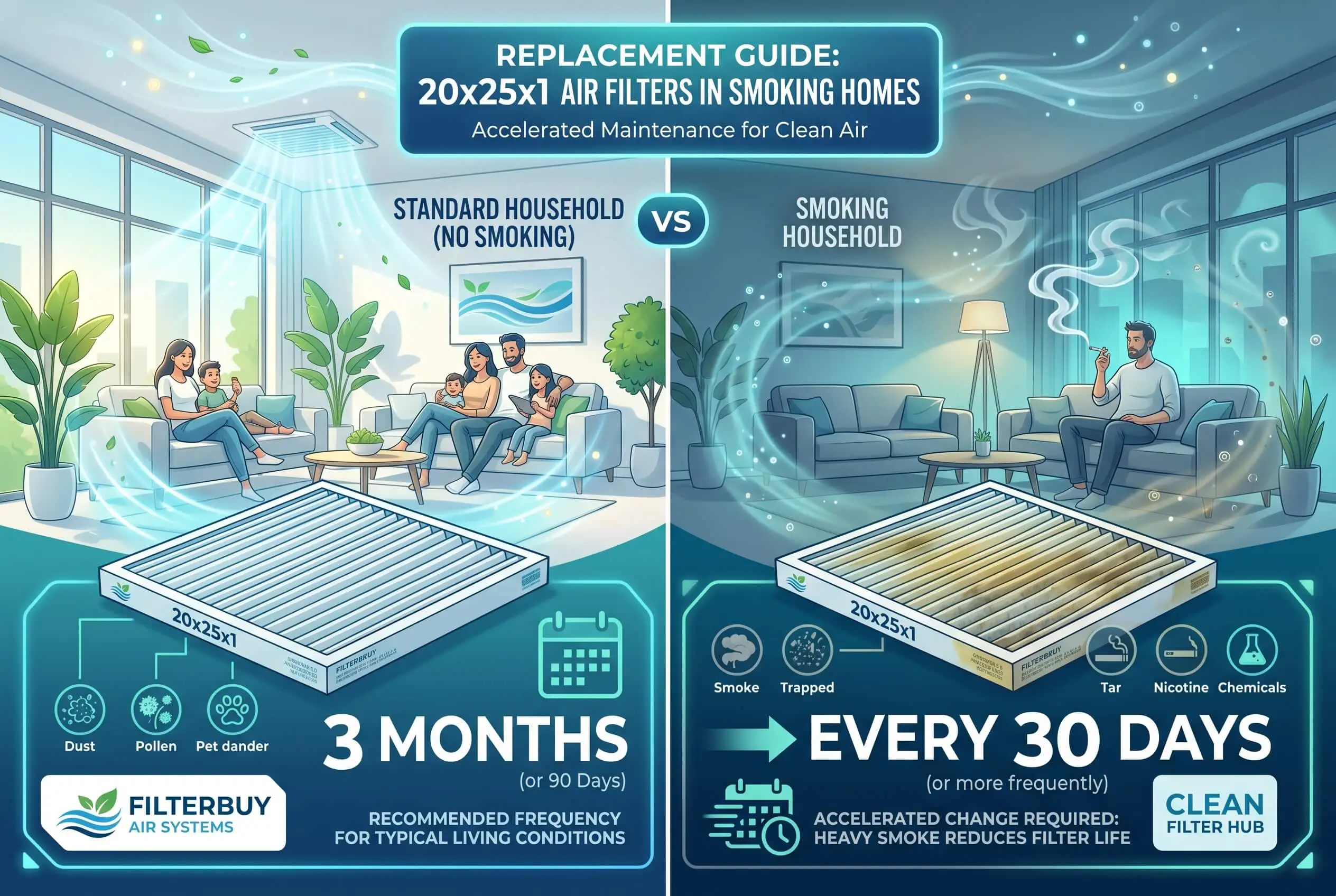
If people smoke inside your home, change your 20x25x1 air filter every 15 to 30 days. Where you land in that range depends on how much smoking happens and in how many rooms. The 60 to 90-day schedule printed on most boxes was built around ordinary household dust, which accumulates slowly and behaves predictably. A 20x25x1 HVAC home air filter offers homeowners a practical, effective way to manage tobacco smoke-related particulates, but that heavier load benefits from a more proactive replacement schedule.
TL;DR Quick Answers
20x25x1 HVAC Home Air Filter
A 20x25x1 air filter measures 20 inches by 25 inches by 1 inch and fits furnaces, air handlers, and HVAC systems with that return air slot size. Available in MERV ratings from 8 to 13, it captures household dust, pollen, pet dander, and — at MERV 11 or higher — fine particulate matter including PM2.5. Most homes should change a 20x25x1 filter every 60 to 90 days. Homes with pets, smokers, or allergy sufferers need a shorter interval: every 15 to 45 days depending on conditions. A clogged filter restricts airflow, strains your HVAC system, and recirculates what it should be capturing — which is why choosing a top air filter matters.
Top Takeaways
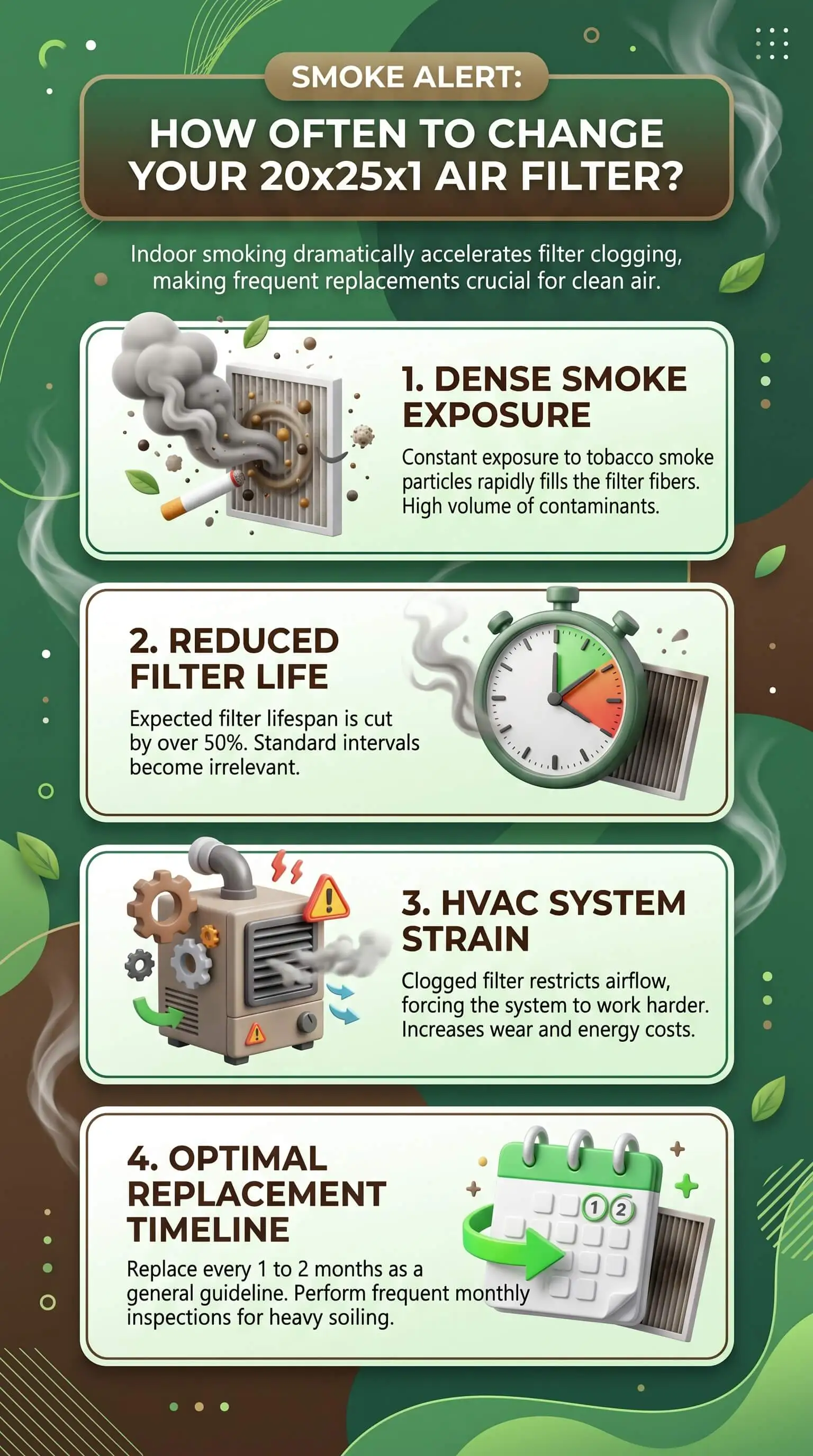
In a smoking household, change your 20x25x1 air filter every 15 to 30 days — not the standard 60 to 90 days.
Match your change frequency to your smoking intensity: light (25–30 days), moderate (15–20 days), heavy or multi-smoker household (10–15 days).
MERV 8 filters are not sufficient for tobacco smoke. MERV 11 is the minimum for any active smoking home; MERV 13 is the strongest practical residential option.
Discoloration, smoke odor returning to clear rooms, reduced airflow, and higher energy bills all signal that your filter has failed before its scheduled date.
Filter changes can't reach your ductwork. Professional air duct cleaning every one to two years is the appropriate interval in active smoking households.
Tobacco smoke generates PM2.5 at concentrations that pass straight through MERV 8 media — the particles that matter most for respiratory health are the ones a standard filter misses.
The EPA confirms that filtration reduces but does not eliminate secondhand smoke. Regular filter changes are the most actionable protection available to homeowners.
Why Cigarette Smoke Burns Through Filters Faster
Tobacco smoke doesn't behave like household dust. When a cigarette burns inside, it releases fine particulate matter — PM2.5, at 2.5 microns or smaller — alongside tar residue, nicotine aerosols, and volatile organic compounds. All of it moves through your HVAC return. All of it lands against your filter media.
A standard residential air filter at MERV 8 was built to catch pollen, dust mites, and lint — particles in the 10-micron-and-above range. PM2.5 from tobacco smoke passes straight through at concentrations high enough to affect your family's respiratory health. The filter collects larger debris on its surface while the smallest, most harmful particles slip through unchecked. It clogs fast, and once clogged, it fails fast.
The 3-Tier Change Schedule for Smoking Homes
20x25x1 air filters don't carry a single right answer in a smoking home. How often yours needs changing tracks directly to how much smoking happens inside, and where. Use these three tiers as your guide:
Light Smoking
One to two cigarettes per day, smoked in a single room. Change your filter every 25 to 30 days.
Moderate Smoking
Three to five cigarettes per day across multiple rooms or common areas. Change every 15 to 20 days.
Heavy or Multi-Smoker Household
More than five cigarettes per day, or more than one person smoking inside regularly. Change every 10 to 15 days. Running a standalone air purifier near the primary smoking area will help at this level, but it doesn't replace the filter change schedule.
If your household falls between tiers — or if guests smoked indoors recently — pull the filter and look at it. A filter that has gone brown or yellow has already run past its effective life, regardless of the calendar.
Choosing the Right MERV Rating for a Smoking Home
In a smoking home, MERV rating is the difference between a filter that actually captures PM2.5 and one that lets it recirculate. That difference affects every person breathing the air in your home.
MERV 8
Adequate for average households managing dust and pollen. At the concentrations indoor smoking produces, PM2.5 passes through. In a smoking home, MERV 8 is the wrong specification.
MERV 11
The minimum for any active smoking household. MERV 11 captures particles down to 1 to 3 microns, which puts it squarely in the range where tobacco smoke's most harmful particles travel.
MERV 13
The strongest practical choice for residential use. MERV 13 filters PM2.5 efficiently without restricting airflow in most home HVAC systems. This is where we'd point most smoking households if their system can support it.
MERV 14 and Above
Built for commercial environments. On older or undersized residential systems, these ratings restrict airflow and push equipment harder than it was designed to run.
Start at MERV 11. If your system can handle MERV 13, make the upgrade. If you're unsure what your equipment supports, ask your HVAC technician before switching.
Warning Signs Your 20x25x1 Filter Is Past Due
In a smoking home, a filter can fail before its scheduled replacement date — especially after heavier-than-usual activity. Most of these signals show up in how your home looks, smells, and feels before you ever pull the filter:
Visible discoloration. White or light gray is healthy. Brown, yellow, or black means the media has absorbed tobacco residue past its effective capacity.
Smoke odor returning to rooms. When tobacco smell spreads to spaces that were previously clear, the filter has stopped trapping enough particulate to contain the odor compounds traveling through your ductwork.
Reduced airflow at registers. A clogged filter narrows what your system can move. The blower strains against it, rooms heat and cool unevenly, and the stress on the equipment builds without any obvious warning.
Higher energy bills. Your HVAC system burns more energy pushing air through a blocked filter. That extra effort shows up on your utility statement — often before you notice it anywhere else in the home.
Worsening respiratory symptoms. A saturated filter recirculates what it should be capturing. Household members with asthma or allergies are typically the first to register when the air quality has slipped.
Other HVAC Considerations in Smoking Homes
Filter changes protect the air handler. They don't touch what accumulates inside your ductwork, and in a smoking home, that gap matters more than most homeowners recognize.
Tar and nicotine build up on duct walls over time, beyond the reach of any filter. For most homes, professional air duct cleaning every two to three years is a reasonable baseline. In an active smoking household, one to two years is the more appropriate interval. Your evaporator coil deserves particular attention — it attracts tar deposits because that's where airflow slows and condensation collects. An annual HVAC inspection that includes coil cleaning protects both the air in your home and the equipment circulating it.
Your 20x25x1 air filter provides an important first layer of protection, helping support cleaner airflow throughout the system. The ducts and mechanical equipment behind it also benefit from their own maintenance schedule, and in a smoking home, staying proactive helps your 20x25x1 air filter perform at its best.
“After manufacturing filters for over a decade, the evidence is visible in every filter we pull from a smoking home — the media is saturated with nicotine and tar deposits in a fraction of the time a standard household filter takes to reach the same state. A MERV 11 or higher filter, changed every two to three weeks, is not excessive in these homes. It is the minimum that makes filtration meaningful.”
7 Essential Resources
1. What the EPA Says About Secondhand Tobacco Smoke and Indoor Air Quality
The EPA is direct: there is no known safe level of exposure to secondhand tobacco smoke, and filtration can reduce indoor exposure but cannot eliminate it. This page explains what filtration can realistically achieve and why smoke-free indoor environments remain the only complete solution.
Source: https://www.epa.gov/indoor-air-quality-iaq/secondhand-tobacco-smoke-and-indoor-air-quality
2. CDC: The Health Problems Caused by Secondhand Smoke
From coronary heart disease and lung cancer to respiratory infections and ear infections in children, the CDC documents the full health profile of secondhand smoke exposure. Read this to understand why indoor air quality management in a smoking home is a health issue, not a maintenance preference.
Source: https://www.cdc.gov/tobacco/secondhand-smoke/health.html
3. American Lung Association: Health Effects of Secondhand Smoke
The American Lung Association covers the respiratory and cardiovascular risks of secondhand smoke for adults and children, with specific attention to why managing air quality in smoking households is a sustained health priority — not something you address once and move on from.
Source: https://www.lung.org/quit-smoking/smoking-facts/health-effects/secondhand-smoke
4. American Cancer Society: Health Risks of Secondhand Smoke
The ACS documents the cancer risks from secondhand smoke exposure, including the way tobacco smoke particles settle on surfaces and continue exposing household members well after the cigarette is out. That's exactly why duct cleaning belongs alongside regular filter changes in a smoking home.
Source: https://www.cancer.org/cancer/risk-prevention/tobacco/secondhand-smoke.html
5. American Heart Association: How Smoking and Nicotine Damage Your Body
The AHA explains how secondhand smoke harms cardiovascular health in nonsmokers, not just smokers. Nearly half of U.S. children ages 3 to 11 are exposed to secondhand smoke, according to data cited on this page. The people sharing your air are not neutral bystanders to your filter's performance.
6. U.S. Department of Energy: Air Conditioner Maintenance and Filter Replacement
The Department of Energy explains how a clogged filter lets debris bypass the media, accumulate on the evaporator coil, reduce system efficiency, and accelerate equipment failure. In a smoking home, every one of those consequences arrives on a compressed timeline.
Source: https://www.energy.gov/energysaver/air-conditioner-maintenance
7. Energy Star: Heating and Cooling Efficiency Guidance
Energy Star recommends checking filters monthly and changing them at minimum every three months. That schedule is already too infrequent for a smoking home. Use this as your reference for what most households do — then apply the smoking-adjusted intervals this page covers instead.
Source: https://www.energystar.gov/saveathome/heating-cooling
3 Supporting Statistics
Secondhand Smoke and Heart Disease Risk
Serving more than two million households, we've watched the filter math shift dramatically the moment tobacco smoke enters the picture. The CDC reports that nonsmokers exposed to secondhand smoke at home or at work face a 25 to 30 percent higher risk of developing coronary heart disease. Your filter's job isn't abstract — it's measured in what it pulls from the air before your family breathes it.
Source: https://www.cdc.gov/tobacco/secondhand-smoke/index.html
EPA Guidance on Filter Efficiency for Indoor Particulate Matter
The EPA recommends choosing a filter rated at least MERV 13 — or the highest rating your system can accommodate — when upgrading residential filters to reduce indoor particulate matter. Tobacco smoke generates PM2.5 directly and at concentrations a MERV 8 filter was never rated to handle. The gap between what that filter captures and what it allows through is precisely where the health risk for your household lives.
Source: https://www.epa.gov/indoor-air-quality-iaq/sources-indoor-particulate-matter-pm
Secondhand Smoke Exposure Among Children
CDC research found that 35.4 percent of nonsmoking U.S. youth between ages 3 and 17 were exposed to secondhand tobacco smoke during 2013 to 2016. Children spend the most time at home, and they're the most vulnerable when filtration is inadequate. A filter overdue by two weeks is two weeks your home isn't protecting them.
Source: https://www.cdc.gov/nchs/products/databriefs/db348.htm
Final Thoughts and Opinion
The 60 to 90-day schedule printed on every filter box was designed for a home where nobody smokes. It doesn't account for PM2.5, tar residue, or nicotine aerosols, and applying it to a smoking home is a decision that plays out in air quality, not convenience.
The households most affected by inadequate filtration in smoking homes tend to be the ones with children, elderly members, or anyone managing a respiratory condition. Your filter is the component in your HVAC system that stands directly between tobacco smoke and the air your household breathes, while aluminum foil tape for HVAC systems helps support overall system integrity. Change it every 15 to 30 days, choose MERV 11 at minimum, and inspect it between scheduled changes whenever smoking volume runs higher than usual.
Changing a filter early costs a few dollars. Waiting too long costs something harder to recover.
Frequently Asked Questions
Q: How often should I change a 20x25x1 filter if I smoke every day?
A: It depends on how much and where. One to two cigarettes per day in a single room: change every 25 to 30 days. Three to five cigarettes per day across multiple areas of the home: change every 15 to 20 days. Heavy daily smoking: change every 10 to 15 days.
Q: What MERV rating do I need for a house where people smoke?
A:
MERV 8: Insufficient. Standard for average households, but cannot capture PM2.5 at the concentrations indoor smoking produces.
MERV 11: The minimum for any active smoking household. Captures particles down to 1 to 3 microns.
MERV 13: The strongest practical residential choice. Efficient PM2.5 capture without restricting airflow on most systems.
Q: Can a 20x25x1 filter remove cigarette smoke smell?
A: A MERV 11 or higher filter, changed on schedule, will reduce airborne smoke particles and some of the odor compounds that travel with them. It won't eliminate every gaseous component. Tar and nicotine that have settled on walls, furniture, and duct surfaces are beyond what any filter can reach — professional duct cleaning and surface cleaning address those.
Q: What happens if I leave a clogged filter in a smoking home?
A:
Airflow restriction: A saturated filter narrows what your system can move, causing uneven temperatures and adding strain to the blower motor.
Increased PM2.5 circulation: Once the media is fully loaded, particles bypass it and recirculate directly into your living spaces.
Energy waste: Your system pushes harder against the blockage, and that extra effort appears on your utility bill.
Equipment damage: Sustained restricted airflow stresses the blower motor and evaporator coil, shortening the system's service life.
Q: Is a MERV 13 filter safe for my HVAC system?
A: For most modern residential systems, yes. MERV 13 delivers strong PM2.5 filtration without the airflow restriction that commercial-grade ratings create. Older systems or those with undersized blowers may need a technician's assessment before you make the switch. A properly fitted MERV 13 filter, changed on schedule, won't harm a system that can support it.
Stock Up Before the Current One Fails
In a smoking home, the next change date arrives faster than the box predicts. Browse 20x25x1 air filters at Filterbuy — MERV ratings from 8 through 13, delivered in the exact size your system takes.